Learn, Unlearn, Relearn: Why curiosity is the most underrated skill of 2026 and beyond
Nathan Spruce
4/29/20267 min read
It's that week in school when the kids have to talk about what their parents do. For my partner it's easy, shes a nurse .... for me not so much so when my daughters were once asked what I did for work, this was their response:
"He's an adult Peter Pan. He tries to make dreams come true with writing and programs and stuff."
I've had performance reviews. I've had client feedback. I've had debrief documents that ran to twelve pages.
Nothing has ever described what I do more accurately than that.
And if I'm honest, nothing has ever better described what genuine curiosity looks like in practice. The refusal to accept that something can't be done differently. The instinct to ask what could be before accepting what is. The slightly exhausting, occasionally maddening, ultimately generative habit of never quite settling for the obvious answer.
That's curiosity and in 2026, it's not a personality quirk ... It's a professional edge.
The world your parents built doesn't work the same way anymore
My dad is brilliant. Genuinely. Decades of experience, hard-won knowledge, a way of seeing problems that I've borrowed from more times than I can count. He also has a phrase I've heard my whole life, deployed whenever a new approach gets suggested:
"But that's the way we've always done it." He says it with complete conviction. Said as if the history of a method is the same thing as its merit.
I say this with enormous affection but that phrase is one of the most expensive sentences in any organisation's vocabulary.
I spent fourteen years working in community services before taking redundancy. Fourteen years of watching what happens when "the way we've always done it" meets communities whose needs have shifted, whose contexts have changed, whose lived experience no longer matches the program designed to serve them.
The programs that worked were rarely the ones with the longest history.
They were the ones built by teams curious enough to ask whether the old approach still fit and brave enough to unlearn it when the answer was no.
We Live in an Age of Infobesity
Here's the paradox sitting at the centre of 2026. We have never in the history of human knowledge had more access to learning. More tools, more courses, more frameworks, more research, more voices from more places than any generation before us could have imagined.
We are the masters of our own development in a way that would have seemed extraordinary twenty years ago.
And yet ... The rate at which industries shift, technologies emerge and entire skill sets become obsolete has never been faster either. Something you learn today may need unlearning within a year or quicker. The AI landscape alone has rewritten whole professional categories in the time it takes to complete a certification in them.
This is infobesity. Not a lack of knowledge an overwhelming surplus of it, moving faster than most people can metabolise it.
The answer isn't to learn more ... It's to learn better. Unlearn faster and relearn with purpose.
The Unlearn Is the Hard Part
Learning is enjoyable. Most curious people actively seek it.
Relearning is satisfying. There's a particular pleasure in building something better from what you've understood.
Unlearning is uncomfortable because it requires admitting that something you were confident in something that worked, that you built practice around, that you may have taught to others no longer serves the situation in front of you.
Here's a personal example: I had to do this with my own communication.
My HBDI profile is 1211: triple dominant, with a strong Yellow quadrant lean. In practice that means I think in patterns and connections, move quickly between ideas and have what my daughters have generously described as "a very active imagination." I can be in five places in a conversation before the room has finished processing the first one.
For a long time I didn't see this as something that needed adjusting. I was moving fast because there was a lot to cover. I was jumping between topics because they were genuinely connected. I was using particular vocabulary because it was precise.
Then my MD asked me to do something that took real courage on her part and real honesty on mine.
She asked me to go and speak with my colleagues not about the work, but about me. To ask them directly what they experienced when we worked together. To genuinely listen to the feedback and bring it back.
What came back was clear. Moves too fast. Jumps between topics without signposting. Sometimes needs to adapt his vocabulary for the room.
Not said unkindly. Said by people who respected me enough to be honest when invited to be.
That was my unlearn moment.
Not a crisis. Not a failure. Just a quiet, uncomfortable recalibration and a deliberate decision to change my approach so that the thinking I was sharing was actually landing rather than just leaving the building at speed.
I slowed down. I signposted transitions. I started checking whether the room was with me before moving to the next idea.
The communication didn't get worse. It got significantly better because the goal was never to speak, it was to be understood.
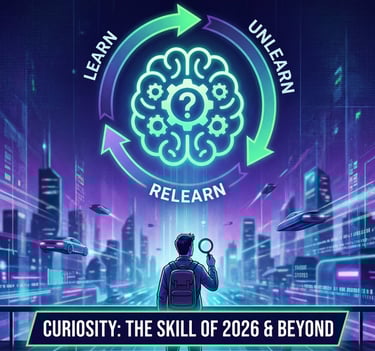
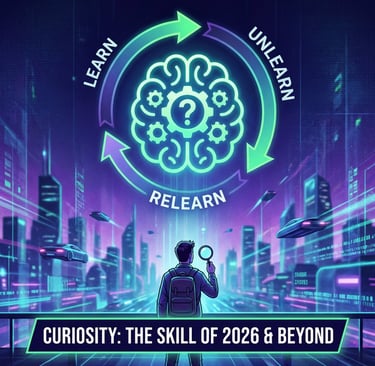
The Learn-Unlearn-Relearn cycle in practice
This isn't a new concept. Alvin Toffler articulated it in 1970. But knowing the cycle and actually running it are two different things.
Here's how it works in practice whether you're leading a community project, designing a place-based program, writing a tender response, or just trying to stay relevant in a field that won't sit still.
Learn: Come in with fresh eyes
Approach every new situation as if your existing knowledge is a starting point, not a conclusion. Gather new data. Listen to voices outside your usual circle. Ask what has changed since you last looked at this problem properly.
In tender writing, as we explored in The Missing How, this is the difference between a response that regurgitates your standard methodology and one that demonstrates genuine reading of the brief, the community and the current context.
In HBDI terms, this is Yellow quadrant work. Big picture. Possibilities. What could be true that isn't yet?
Unlearn: Challenge what you brought with you
This is the step most teams skip because it's the most uncomfortable.
Ask directly: why did this approach work before and does it still apply now?
In community services, I watched this question transform programs that had calcified into habit. The ones willing to ask it and sit with the discomfort of the answer built things that actually met current need. The ones who couldn't ask it kept delivering to a community that had quietly moved on.
Run a quick unlearn audit with your team. List your current approaches. Test each one against today's context. Be honest about what you're keeping because it works and what you're keeping because it's familiar.
They are not the same thing.
Relearn: Build something better from what you now know
This is where experience becomes genuinely valuable not as a template, but as a foundation.
The most powerful relearns I've seen in tender writing happen when a team analyses what worked and what didn't across previous bids, then uses those specific learnings to design something genuinely new. Not a recycled methodology with updated dates. A fresh approach built from honest reflection on real outcomes.
That's not just better tender writing. It's the design process for every good community program ever built.
Apply and Reflect: Close the loop
Put the new approach into practice. Then review it honestly. What worked? What needs adjusting? What did you learn that goes into the next cycle?
Document it. Not in a forty-page lessons-learned report nobody reads but in a simple, honest record of what changed and why. That document becomes the foundation of your next Learn.
What low curiosity actually costs
It's worth naming this clearly because curiosity isn't evenly distributed in rooms and the reasons for that are more nuanced than they first appear.
Low curiosity can look like poor participation, fixed or narrow mindset. A phrase that encapsulates this is conversion over conversation. The pursuit of agreement rather than understanding. Telling rather than asking. Closing down rather than opening up.
But here's what I've learned in fourteen years of community services work: Low curiosity is not always a character trait.
Sometimes it's a symptom of an environment that never made it safe to ask questions. Never rewarded the person who said "I don't know but I'd like to find out." Never created the conditions where genuine not-knowing was treated as a starting point rather than a weakness.
Those environments exist everywhere and disturbingly the people inside them often carry latent curiosity that organisations never knew they had because nobody ever handed them the pen and said your thinking matters here too.
That's one of the reasons the whiteboard matters in co-design. Not as a surface but as an invitation.
When you give someone the marker and mean it, when you create a space where their question can genuinely change the direction, you don't just get better outcomes. You discover who in the room was curious all along and never had somewhere to put it.
Making Curiosity a Daily Practice
A few practical moves that cost nothing:
Start every new project with one question before any other: "What do we need to unlearn here?"
Keep a curiosity log, not a journal, just a simple running note. What did I learn this week? What did I let go of? What am I building differently as a result?
When someone in your team says "but that's the way we've always done it" and they will ... don't dismiss it. Ask the question underneath it: "What are we actually afraid of losing if we change this?" The answer is usually more useful than the resistance.
If you have one, use your HBDI profile. Know where your team's Yellow quadrant lives ... the big-picture, possibility-oriented thinking that drives genuine curiosity. If it's thin, name that gap early and find ways to activate it. If it's strong, like mine, make sure there's also someone in the room whose Green quadrant keeps the ideas tethered to what can actually be implemented.
The adult Peter Pan needs an operator who loves them enough to say "yes, and here's how we land the plane."
The bottom line
The most valuable professionals in 2026 won't be the ones who know the most. They'll be the ones who can learn something new, let go of something old, and build something better and faster than the field is moving.
Static knowledge has an expiry date, curiosity doesn't.
My dad taught me that there's an equation for every occasion. That everything has a path, a framework, a method ... you just have to find it.
The equation for this one is simple:
Genuine curiosity + willingness to unlearn + the discipline to relearn with purpose = relevance that compounds
Find it. Practice it. Hand someone else the marker.